
Education
90%
block decrease
10+
years of
experience
September 2, 2026
5 min read

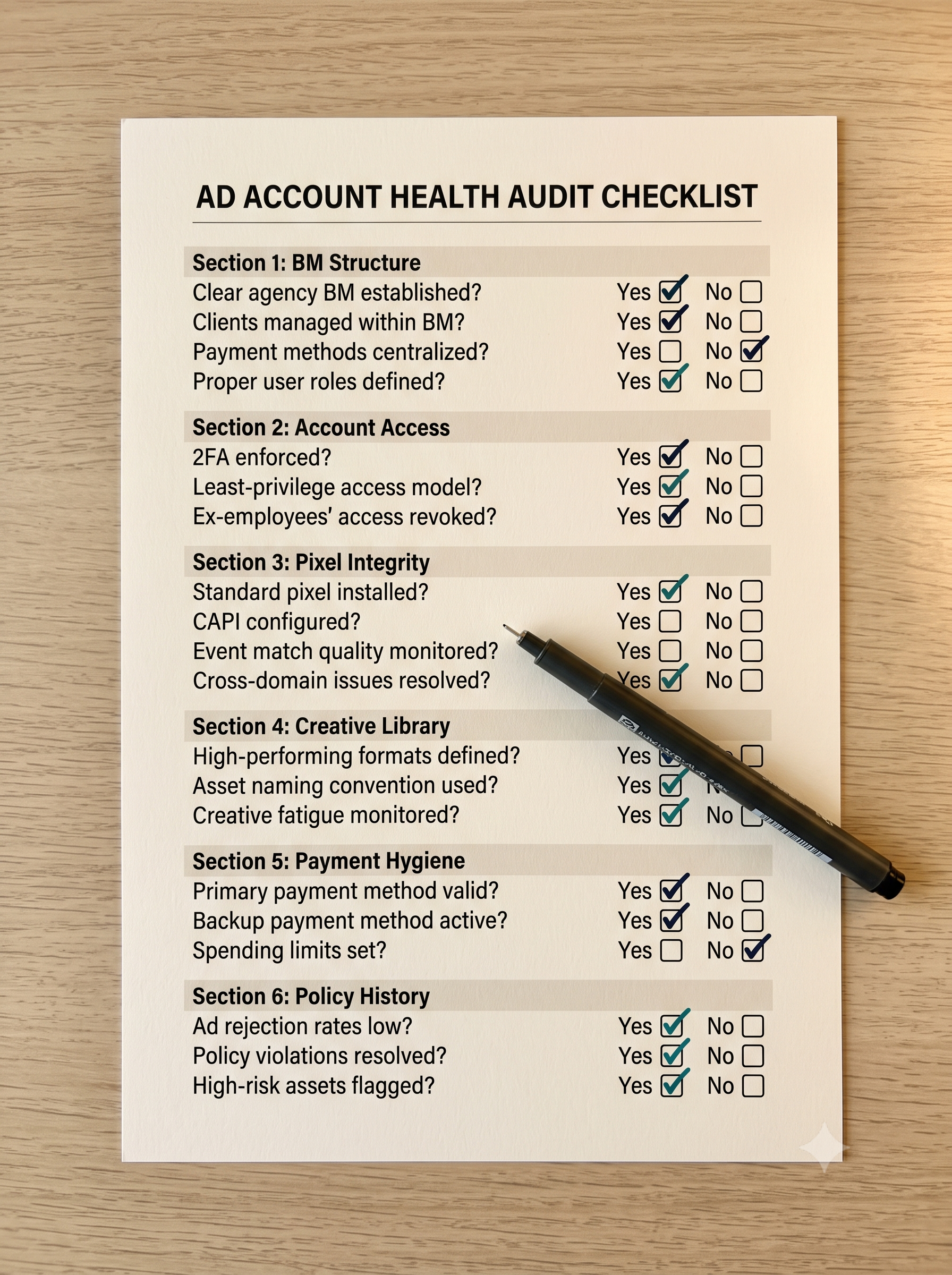
Quick answer: A quarterly ad account health audit covers six areas: Business Manager structure and hierarchy, account roles and access permissions, pixel and data integrity, creative library risk, payment and credit hygiene, and policy violation history. Each area takes 4–5 minutes to check with a clear set of yes/no questions. The agencies that run this audit quarterly catch structural risks before the platform does — and avoid the suspension events, cross-contamination incidents, and billing disruptions that most agencies only discover reactively. At Quority, this audit runs automatically for every agency partnership, every week.
By then, the damage is already done. The suspension happened. The pixel was sharing data it shouldn’t have been sharing for three months. The account that just got flagged had a former team member with admin access that nobody removed. The payment method that failed had been inconsistent for weeks before it caused a billing disruption.
None of these are unforeseeable events. They’re all visible in advance — if you know where to look and take 30 minutes every quarter to look there.
This audit covers six areas. Each takes under five minutes. The questions are yes/no. At the end, you’ll have a clear read on where your account setup is exposed — and a short list of fixes that are almost always faster to address before a problem than after one.
An ad account health audit is a structured review of the six components of an agency’s advertising account infrastructure most likely to generate platform-level problems: Business Manager structure and hierarchy, account roles and access control, pixel and data integrity, creative library risk, payment and credit hygiene, and policy violation history. Unlike a campaign performance audit — which looks at results — an account health audit looks at the structural conditions that determine whether those campaigns can run without disruption.
Most agencies conflate the two. Campaign performance is what you review weekly. Account health is what you review quarterly — and it’s the one that prevents the events that can take a week of senior-team time to recover from.


Work through these in sequence. The first two sections take the longest on first run; they get faster each quarter as the baseline is already established.
Section 1 — Business Manager Structure and Hierarchy (~6 min)
This is the foundation everything else sits on. A messy BM structure is the single most common source of account health problems we see across agency partnerships.
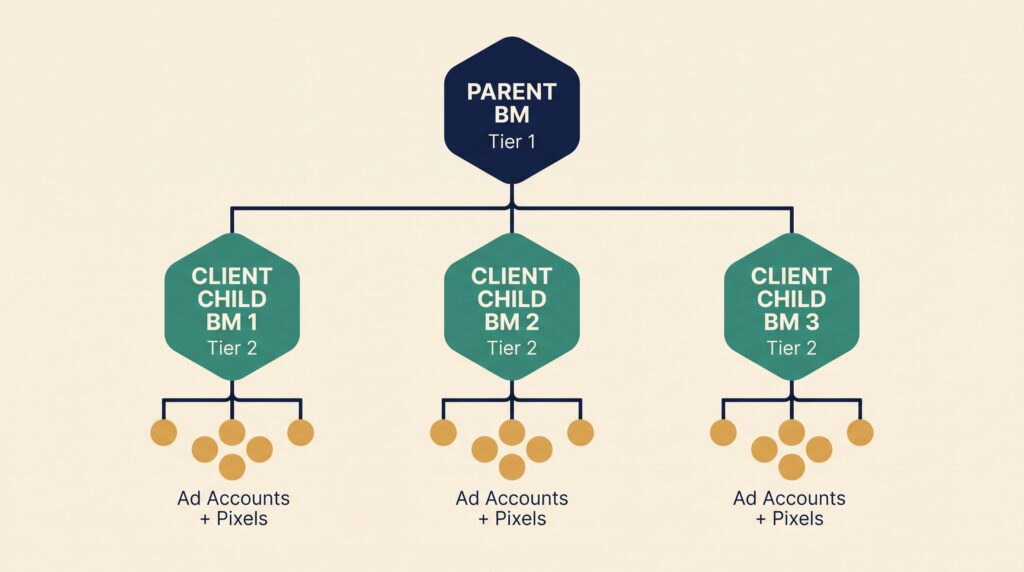
- Does your agency have a single verified parent Business Manager?
- Does each client have their own isolated child BM — no shared structure across clients?
- Is the parent BM verified with a legitimate business entity that matches your ad account details?
- Are there any old, unused, or “test” BMs still connected to your parent structure?
What to do if the answer to any of these is no: BM structure issues are the most important to fix and the most disruptive to leave.
Section 2 — Account Roles and Access Permissions (~6 min)
Access control issues are the most frequently overlooked structural risk. Former employees, freelancers, client-side contacts, and test accounts all accumulate admin access that nobody actively revokes.
- Does every person with admin or advertiser access to your BM still work with your agency?
- Are former employees, freelancers, or past clients removed from all accounts and BMs?
- Do any accounts have personal Facebook profiles with admin access (rather than business accounts)?
- Are permissions scoped correctly — do people have only the access level their role requires?
What to do if the answer is no: Remove unnecessary access immediately. This takes 10 minutes and has no downside.
Section 3 — Pixel and Data Integrity (~5 min)
Pixel setup issues are where cross-contamination spreads most silently. Shared pixels create invisible linkage between clients that platforms read continuously.
- Does each client have their own dedicated pixel — no shared pixels across multiple clients?
- Are all pixels firing correctly (verify via the Meta Pixel Helper or Events Manager)?
- Are Custom Audiences up to date — no audiences built from stale or non-consented data?
- Are any pixels installed on domains that are no longer active or owned by current clients?
What to do if the answer is no: Shared pixels are a structural problem, not a quick fix — but auditing which pixel belongs to which client is the first step.
Section 4 — Creative Library Risk (~4 min)
The creative library is where compliance risk accumulates invisibly. Ads that ran fine six months ago may not pass current policy review today.
- Are there active or paused ads in the library that used claims or offers that are no longer accurate?
- Are there ads referencing promotions, pricing, or landing pages that have since changed?
- Are there ads with rejected or disapproved status that haven’t been reviewed and resolved?
- Have any creatives been recycled from one client account into another?
What to do if the answer is no: Archive outdated creatives, resolve all pending disapprovals, and document a policy that creatives are never reused across client accounts.
Section 5 — Payment and Credit Hygiene (~4 min)
Payment inconsistency is one of the six trust signals Meta and Google evaluate continuously. A clean payment history is a structural asset; an inconsistent one is a liability that compounds.
- Is there one stable primary payment method per Business Manager (not rotated frequently)?
- Have there been any failed charges, declined payments, or billing disputes in the last 90 days?
- Are payment methods current — no expiring cards, no outdated billing addresses?
- For agencies on credit-line billing: is the credit account in good standing with no overdue balances?
What to do if the answer is no: Update payment methods immediately — an expired card that fails on a live campaign is a preventable disruption.
Section 6 — Policy Violation and Rejection History (~5 min)
Rejection history is the quietest structural risk in the audit — because it doesn’t show up as an immediate crisis. It shows up as a gradual worsening of ad review outcomes over months.
- What is the rejection rate on ads submitted in the last 90 days — has it increased?
- Are there any active policy flags, account-level warnings, or Account Quality issues on any account?
- Have there been any suspensions or restrictions in the last 6 months — and were the root causes addressed?
- Are landing pages reviewed against current policy before each new campaign launch?
What to do if the answer is no: Rising rejection rates require investigation — they rarely self-correct.

After running all six sections, you’ll have a list of items where the answer was no or uncertain. Prioritise them in this order:
The agencies that run this audit quarterly rarely face the events that take a week to recover from. The agencies that run it reactively — after a suspension, after a cross-contamination incident, after a billing disruption — spend that recovery week wishing they’d spent 30 minutes three months earlier.
A quarterly ad account health audit covers six areas: BM structure, account access, pixel integrity, creative library, payment hygiene, and policy violation history — 30 minutes total.
The most common structural risk agencies miss is unrevoked access from former employees and freelancers — a 10-minute fix that most agencies delay indefinitely.
Shared pixels across multiple clients create invisible cross-contamination pathways that platforms read continuously — one client’s declining performance can affect another’s account without any direct connection between their campaigns.
Rising rejection rates are always visible in the data before they trigger account-level review — catching the trend in a quarterly audit prevents the crisis that a reactive audit can only document.
At Quority, this six-section audit runs automatically for every agency partnership every week — account health monitoring is part of the infrastructure, not a separate task.

At Quority, the six areas covered in this audit run continuously for every agency we partner with — not as a quarterly task, but as an automated weekly check built into the platform. Account structure issues, access anomalies, pixel integrity, payment health, and policy violation signals are all monitored and flagged before they become platform events.
If you’ve run this audit and found issues you’re not sure how to resolve — or if your agency is at a scale where manual quarterly audits are no longer sufficient — get in touch with the Quority team. We’ll review your current account structure and show you exactly where the exposures are.
Stacks is a production-ready library of stackable content blocks built in React Native.
block decrease
years of
experience
block decrease
years of
experience

block decrease
years of
experience
block decrease
years of
experience

block decrease
years of
experience

block decrease
years of
experience


