
Education
October 8, 2026
5 min read
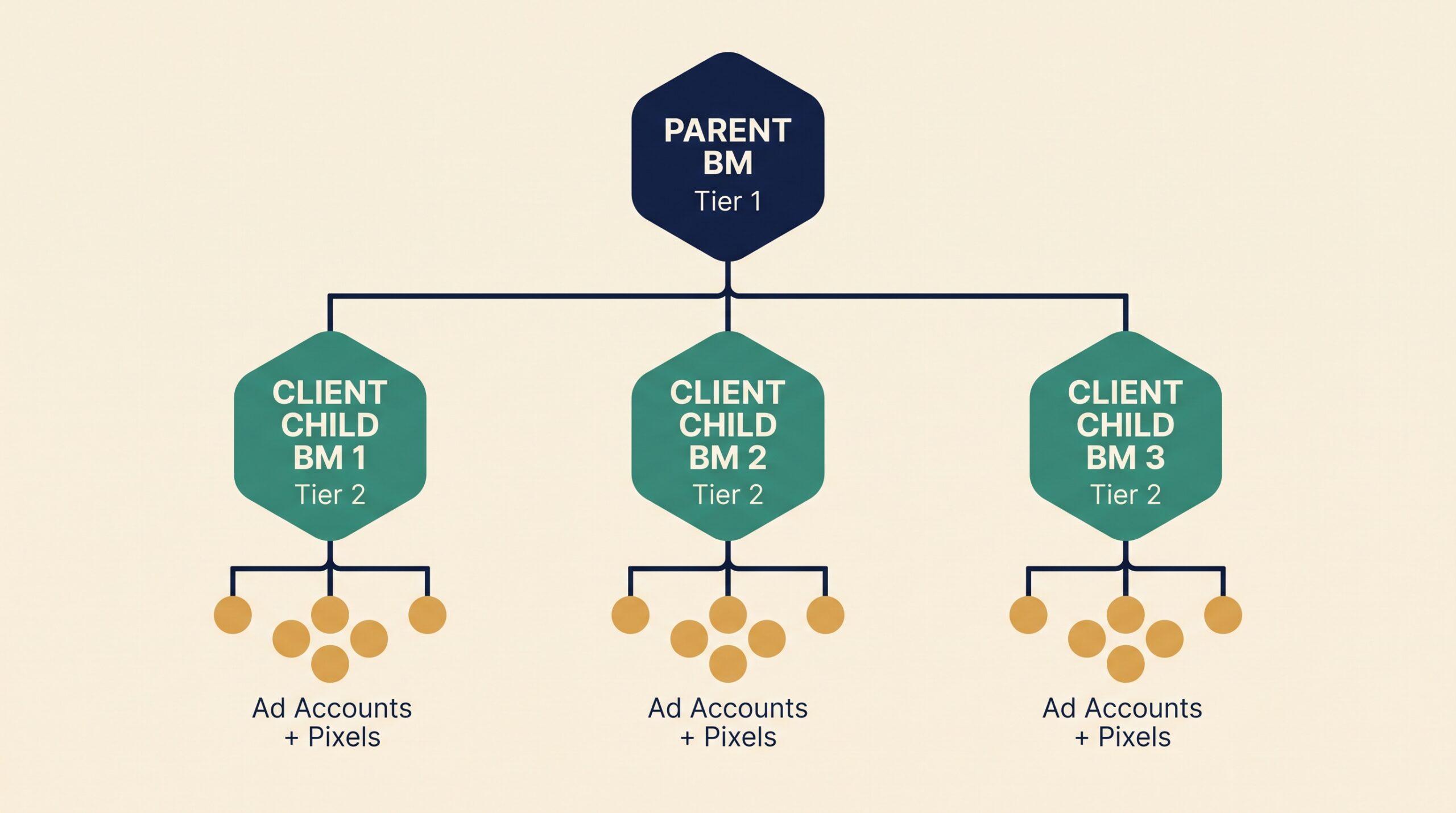
Quick answer: The correct ad account structure for agencies managing multiple clients is a three-tier hierarchy — one verified parent Business Manager at the agency level, one isolated child Business Manager per client, and dedicated ad accounts and pixels nested within each client's BM. This structure prevents cross-contamination between clients, allows clean access control, and lets each client's account build its own trust history independently of every other account in the agency.
Every other operational decision an agency makes sits downstream of how its ad accounts are structured. Hiring, client onboarding speed, spend cap headroom, and how quickly an agency can recover from a suspension are all shaped by decisions made — or skipped — when the account hierarchy was first built. Get the structure right at ten clients and it holds at fifty. Get it wrong at ten clients and every additional client compounds the exposure.
Most agencies inherit their structure rather than designing it. A founder opens a Business Manager to run the first client's ads, adds the second client into the same BM because it is quicker, and by the fifth client the agency is running a shared structure that nobody would choose if they were starting today. The fix later is always more expensive than the discipline would have been at the start.
This guide brings together everything a multi-client agency needs to build — or rebuild — that structure correctly: the three-tier Business Manager hierarchy, pixel and data architecture, access control, payment and credit structure, and how each of these differs on Google Ads and TikTok Business Center. It closes with the complete setup checklist to run before a single new campaign goes live.

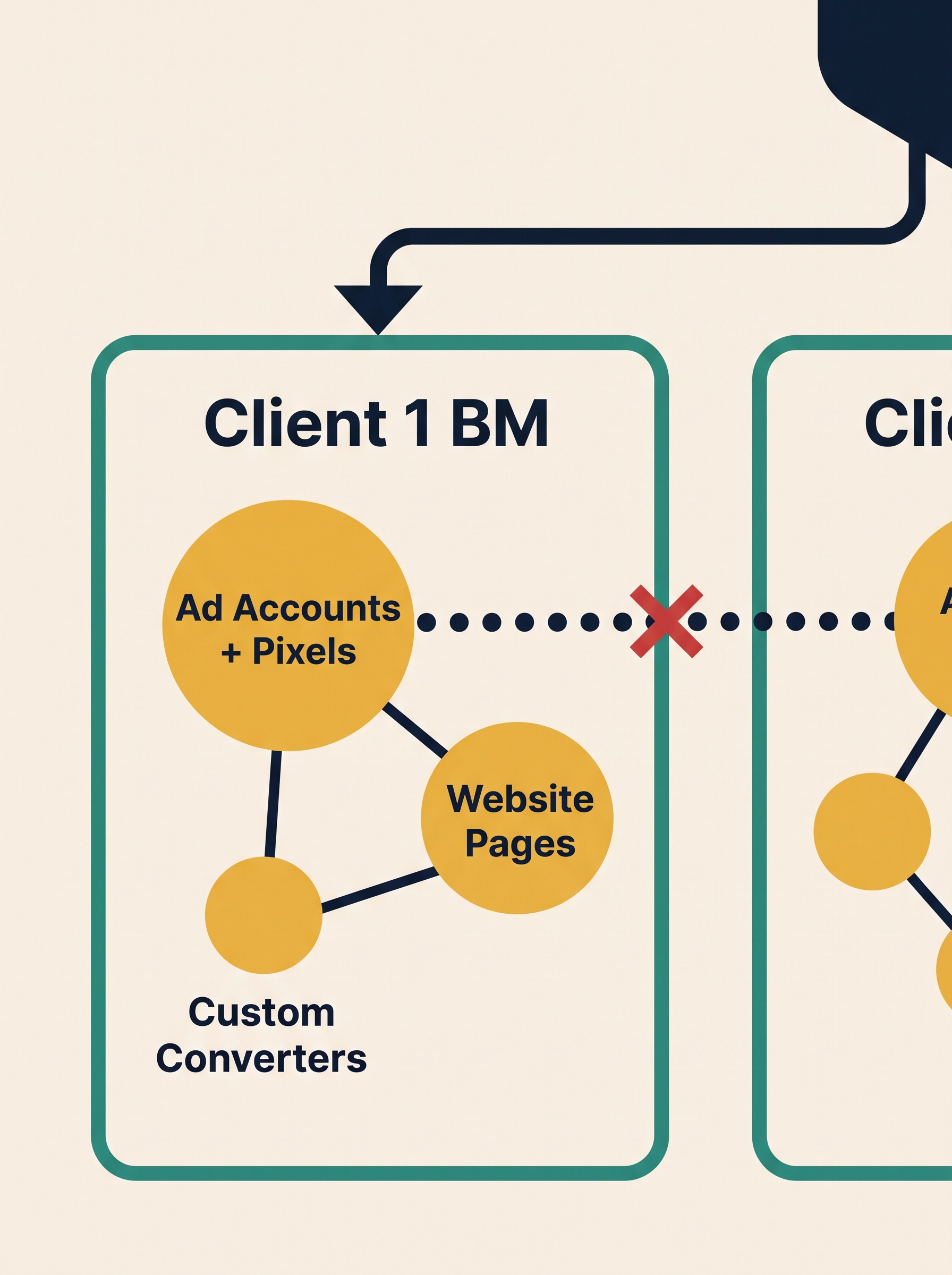
What belongs at each tier:
A shared pixel is the fastest way to link two clients' accounts that otherwise have no business being connected. Pixels do not just measure conversions — they build a signal history that platforms read continuously, including audience overlap, domain association, and performance patterns. Once a pixel has touched more than one client's domain, that history cannot be cleanly separated again.
The rule is simple: one pixel per client, installed only on that client's domains, created fresh within that client's child BM rather than copied or repurposed from an existing account. This applies even when two clients operate in similar or identical verticals — similarity of offer is not a reason to share measurement infrastructure.
Custom Audiences carry the same risk in a different form. An audience built from stale or cross-contaminated pixel data can quietly degrade delivery quality on a client's account without any error message or obvious trigger. Reviewing Custom Audiences for stale or improperly sourced data is part of the structural baseline, not an optional extra.

Access accumulates. It rarely gets removed. Every agency that has operated for more than a year has former employees, freelancers, and past client contacts still holding admin or advertiser roles somewhere in its BM structure — usually because removing access was never built into any offboarding process.
The correct role architecture scopes access at three levels: agency-wide roles limited to senior operations staff who need visibility across the whole parent BM, client-level roles limited to the team actively working that account, and time-bound roles for freelancers or contractors that are removed the moment the engagement ends. Personal Facebook profiles should never hold admin access — every admin role should sit on a verified business account.
The habit that prevents access sprawl is a standing quarterly review: who has access to what, whether they still need it, and whether the access level matches their current role. This is one of the six areas covered in a full quarterly account health audit — see how to audit your agency's ad account health in under 30 minutes for the complete review process.
Payment consistency is a trust signal, not just an accounting detail. Platforms track payment reliability continuously, and inconsistent billing — rotating cards, failed charges, disputes — feeds into the same trust evaluation that affects spend caps and account review frequency.
At multi-client scale, each client's child BM should carry its own dedicated, stable payment method rather than a shared card used across several clients. Shared billing creates the same kind of cross-client linkage that shared pixels do, just through a financial pathway instead of a data one.
Credit-line accounts change the calculation for agencies running higher volumes. Rather than each client's account building spend-cap headroom from zero, accounts provisioned through a verified partner inherit trust signals from the parent structure and operate on credit-cycle billing rather than card-per-transaction charges. We cover the mechanics of accessing this structure in how to get agency credit lines on Meta and Google without being a certified partner.
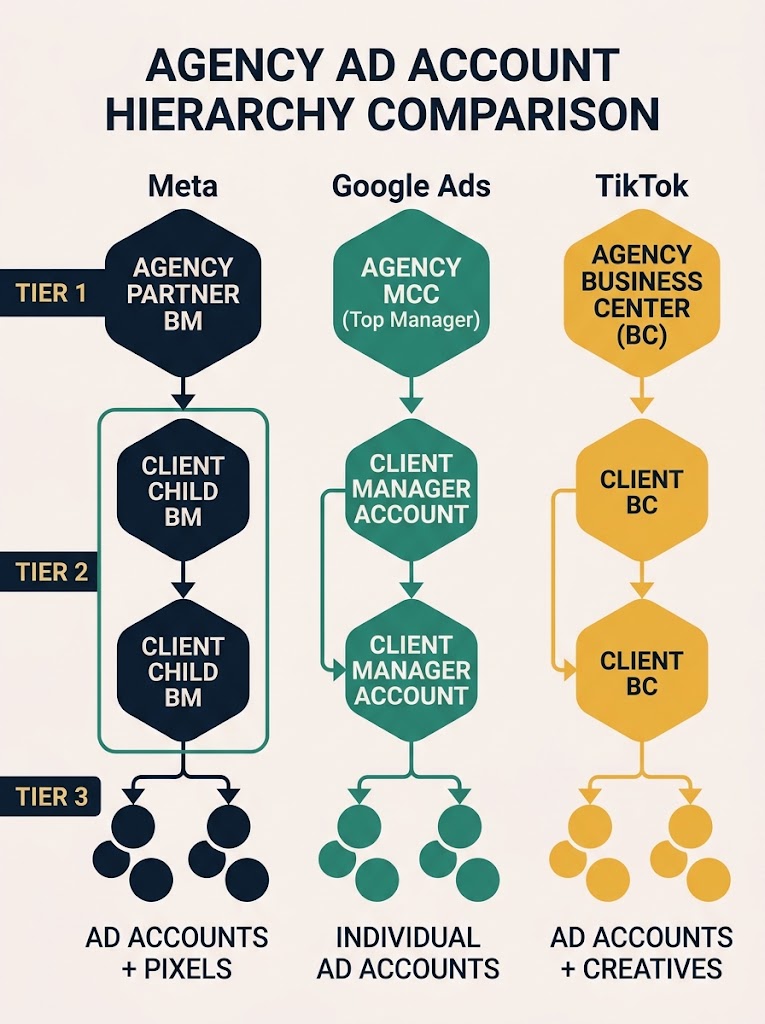
How Does Structure Differ on Google Ads and TikTok Business Center?
The isolation principle is the same. The mechanics are platform-specific. On Google Ads, the parent BM is replaced by a Manager Account (MCC), sitting above individual client accounts rather than above child BMs. The most common structural failure on Google Ads is not a missing hierarchy — most agencies do have an MCC — but running multiple clients inside a single account using campaign-level labels instead of full account isolation. That pattern creates the same contamination risk as sharing a Business Manager on Meta, just under a different name.
Conversion tracking isolation matters just as much on Google as pixel isolation does on Meta. Each client needs their own conversion tracking setup, with no shared tags or shared analytics properties feeding attribution across clients. Payment structure follows the same rule: dedicated billing per client account, not a personal payment method tied to the MCC covering multiple clients underneath it.
TikTok Business Center follows a comparable hierarchy — a Business Center at the agency level, with individual ad accounts and pixels beneath it — but the underlying trust system is newer and less documented than Meta's or Google's. That makes structural mistakes easier to make and harder to diagnose, since there is less established guidance on what TikTok's systems specifically flag. The safest approach is to apply the same isolation discipline used on Meta and Google — one client, one isolated account, one pixel — until TikTok's own enforcement patterns are better understood.
Before any new client's first campaign goes live — or before restructuring an existing client relationship — confirm each of the following:
At Quority, this three-tier isolation model is the structural baseline for every agency partnership we build — verified parent BM, isolated child BM per client, dedicated pixels, scoped access, and credit-line billing, applied consistently across Meta, Google, and TikTok. Account health monitoring runs on top of that structure every week, so drift back towards shared accounts or reused pixels gets caught before it becomes a platform event.
If your agency's structure has grown organically rather than by design — or if you are rebuilding after a suspension or cross-contamination incident — get in touch with the Quority team. We will review your current hierarchy against this framework and set out exactly what needs to change before your next client onboards.
Stacks is a production-ready library of stackable content blocks built in React Native.



block decrease
years of
experience

block decrease
years of
experience

block decrease
years of
experience


