
Education
90%
block decrease
10+
years of
experience
September 2, 2026
5 min read

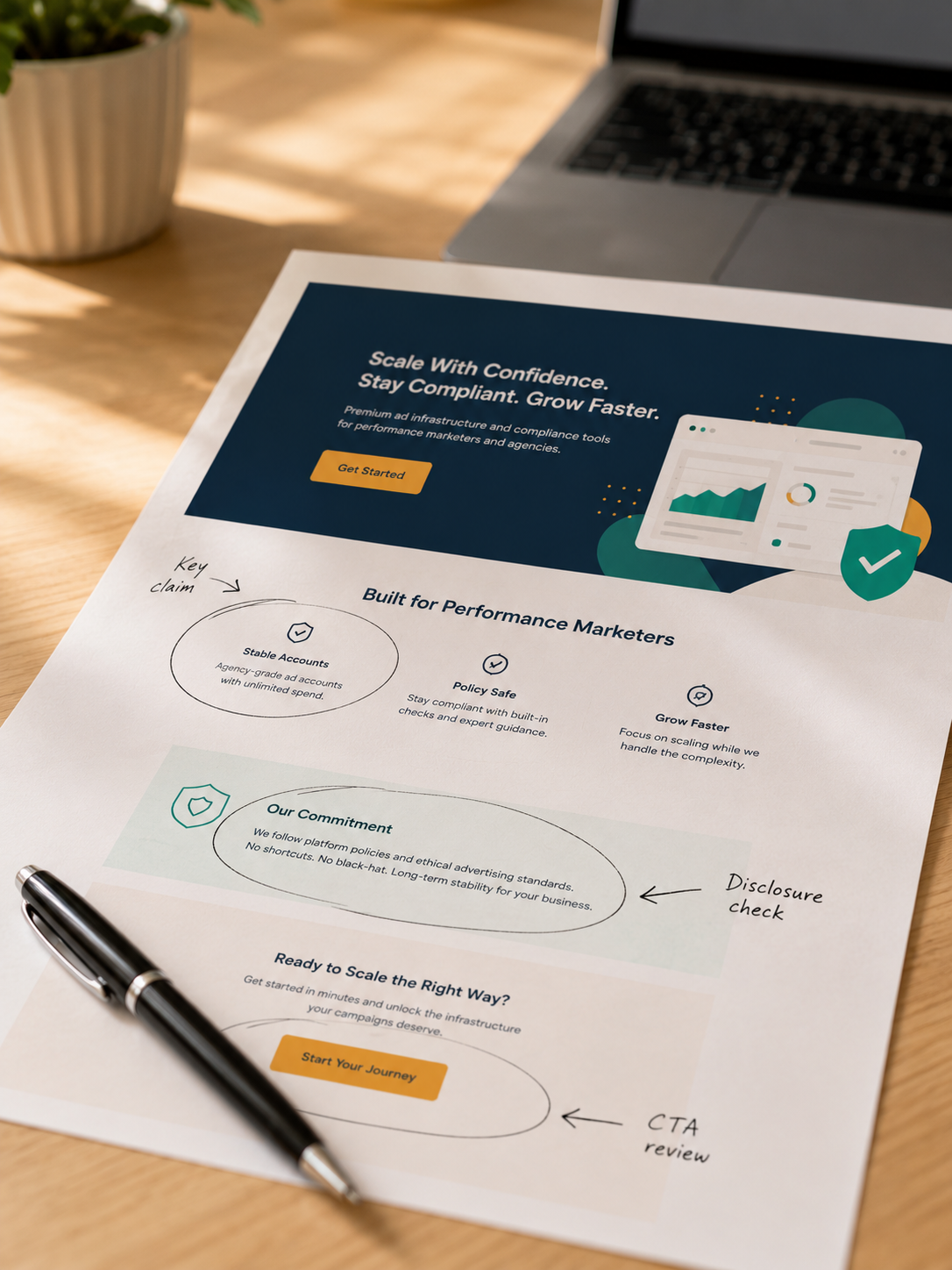
....then disapproved three days later, when nothing on the creative changed. Or your ad set ran for two days, then the entire ad account got flagged because of an offer the team had checked twice before submitting.
If that's a pattern you've seen, the issue almost certainly isn't the ad. It's the landing page — and the platform's policy review didn't fire until the crawler caught up to your offer page two or three days after launch.
About half of all paid ad rejections on Meta and Google originate at the landing-page layer, not the creative. Yet most agency compliance review focuses entirely on the ad itself and never inspects the LP against current policy. This article walks through what Meta and Google actually check, where the two platforms differ, and the pre-launch checklist that catches the rejection before it happens.
Meta and Google both run this check on every active ad — but the timing is what trips up agencies. The creative is reviewed at submission. The landing page is reviewed continuously, by automated crawlers that revisit your destination URL on their own schedule. Which means an ad can be approved on Monday, with a "clean" landing page at submission, then disapproved on Wednesday when the crawler picks up a change you made to the page on Tuesday.
The implication: landing-page compliance is a continuous obligation, not a one-time check. Anything that changes on the destination page after launch can trigger a rejection
The platforms run analogous checks, but the way they enforce them is meaningfully different.
Meta is more aggressive on claims and disclosures. Health claims, income claims, finance claims, before-and-after framing, and unsupported superlatives ("the best", "guaranteed") all trigger Meta's landing-page review more reliably than they trigger Google's. Meta also enforces tighter consistency between the ad's stated offer and the landing page's actual offer — if the two diverge meaningfully, Meta flags the ad even if both are individually compliant.
Google is more aggressive on structural integrity. Redirect chains, cloaking patterns, mobile parity, and page load times affect Google's landing page evaluation more than they affect Meta's. Google also evaluates the page's user-experience signals — bounce rate, dwell time, mobile usability — as part of the broader Ad Rank calculation, which means a "compliant but bad" landing page can still hurt your campaign even if it never gets formally disapproved.
Both platforms penalise broken trust signals: missing privacy policy, missing terms of service, missing contact information, business identity that doesn't match the ad account, and absence of basic page security (HTTP instead of HTTPS).
The same trust signals that affect ad review also affect your overall account standing — we covered how they compound in what "clean advertiser" actually means in 2026 and why platforms reward it.
Meta's advertising policy documentation and Google Ads policy center are the canonical sources for the specific rules. Both update their policies multiple times a year — bookmark them, don't rely on memory.


These are the categories every agency's pre-launch LP review should cover.
1. Claims and disclosures. Income claims, health claims, finance claims, and any "results-based" framing need disclaimers visible on the page — not buried in fine print three scrolls down. Both platforms scan for the disclaimer's presence and approximate position relative to the claim.
2. Trust signals. Privacy policy, terms of service, contact information (real, reachable), and business identity. These need to be present, accurate, and consistent with the ad account's business verification.
3. Page security and structure. HTTPS required. No mixed content. No suspicious script tags. No redirect chains longer than two hops between the ad click and the final destination.
4. Cloaking detection. Showing one version of a page to platform crawlers and a different version to actual users. This is one of the fastest paths to a permanent ad-account ban — both platforms detect it aggressively.
5. Mobile parity. The mobile version of the page must contain the same compliance elements as the desktop version. Many landing-page builders strip disclaimers on mobile by default — agencies get caught by this routinely.
6. Offer-to-page consistency. What the ad promises must match what the landing page delivers. If the ad headline says "free trial" and the page asks for a credit card, the ad will be flagged for offer mismatch even if every other element is clean.
7. Restricted-category compliance. If the landing page touches a restricted category — finance, health, dating, gambling, alcohol, anything age-gated — additional category-specific rules apply on top of the general policy. Each platform's restricted-category list differs slightly; check both before launching.
Before any ad with a new LP goes live, walk through these six checks. Should take under 30 minutes per landing page.
Agencies that run this check consistently see rejection rates drop measurably — based on our network's pre-approval data, well-managed LP review reduces post-launch rejections by about 40–60% compared with agencies that skip it.
For context on how rejection patterns at the landing page layer interact with broader account health, see why your Meta agency account keeps getting suspended.


At Quority, every campaign that runs through our credit-line agency accounts goes through a pre-approval process that includes landing-page review — claims, disclosures, structure, mobile parity, and offer-to-page consistency, against both Meta and Google's current policy. It's part of the partnership, not a separate service.
If your agency's rejection rate is climbing and you suspect the landing page is the source, get in touch with the Quority team. We'll review the LPs on your last batch of rejected ads and tell you exactly which checks they failed.
Stacks is a production-ready library of stackable content blocks built in React Native.
block decrease
years of
experience
block decrease
years of
experience

block decrease
years of
experience

block decrease
years of
experience
block decrease
years of
experience

block decrease
years of
experience


