
Education
90%
block decrease
10+
years of
experience
September 2, 2026
5 min read


You burned through three ad accounts last week...
...and your provider says they have ten more ready to go. Faster delivery, lower per-account price, no questions asked. The whole pitch is built around supply — whatever gets banned, we replace.
If this is the rhythm your agency has settled into, the problem isn't really your supply. The problem is the type of accounts you're using, and the workflow you've built around constantly replacing them.
This article is about why account quality matters far more than account quantity, what the hidden costs of the stack-and-burn model actually are, and what changes when you switch to premium infrastructure.
It exists because agencies running in difficult verticals — or with high-rejection-rate creative — needed a way to keep campaigns live when accounts kept dying. The solution the market built was straightforward: cheap, disposable accounts that come in fast and get replaced when they die.
For a while, that worked. Volume of supply was the whole point. If you lost five accounts in a week, you ordered five more on Monday. The accounts were treated as consumables.
But the model has a structural problem that gets worse the more your agency scales. The disposable accounts were never built to be stable. They're frequently farmed, recycled from previous owners, set up on rushed business entities, and connected to infrastructure with mixed history. They behave the way you'd expect anything cheap and disposable to behave — they break.
Premium ad accounts aren't more expensive because of the brand on them. They're more expensive because of what sits behind them.
Account age and history. A clean account that has existed and run compliant campaigns for years behaves very differently from one set up last week. Platforms reward consistent behaviour and penalise newness. Older, clean accounts get higher trust scores, more stable delivery, and significantly less exposure to automated review triggers.
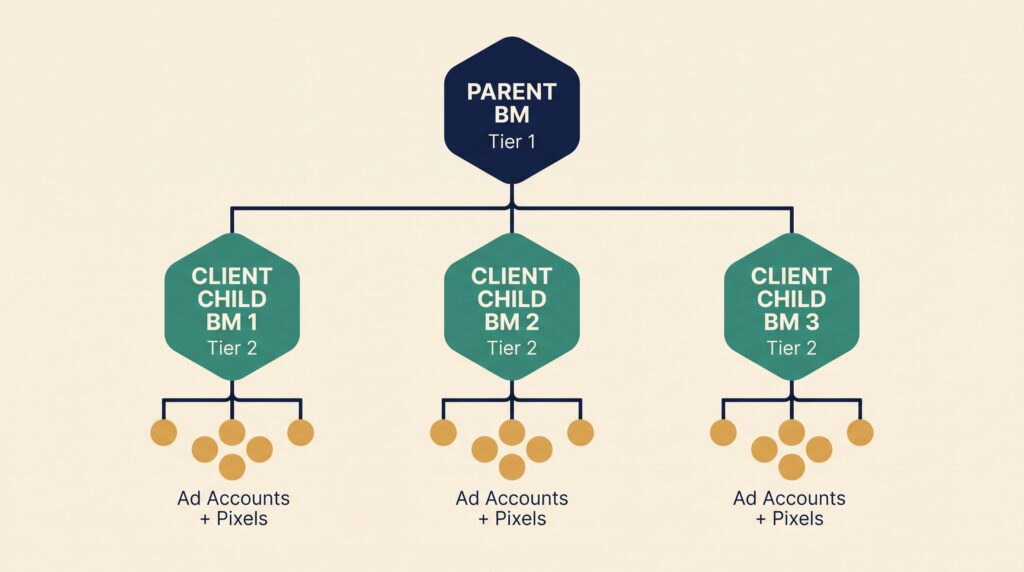
Parent Business Manager standing. Quality accounts sit under a verified parent BM with its own clean history, business verification, and payment record. The child accounts inherit that trust. Disposable accounts almost always sit under thin, freshly-built BMs with none of those signals.
In-house, audited, and isolated. Quality accounts aren't recycled from a previous owner whose violations are now part of the account's history. They're created and held in-house, audited for compliance, and structurally isolated so one account's issue can't bleed into the others.
Credit line and platform-tier access. Premium accounts come with credit lines, higher daily spend caps, and access to escalation paths most agencies can't reach on their own. That's not a "nice to have" — it's the actual operational difference that decides whether you can scale a client past $50k a month without your infrastructure becoming the bottleneck.
The cheap-per-account price is the only line item that makes the stack-and-burn model look attractive. Once you add in everything else, the math turns.
Team time spent on replacement, not strategy. Every account that dies is an hour or two of your senior media buyer's time on setup, audience rebuilds, tracking re-installs, and pixel re-warming. Multiply that across five replacements a week and you've quietly converted strategy time into admin time.
Campaign continuity damage. Every time a campaign restarts on a fresh account, the learning phase resets. CPMs spike. Performance dips. The first 72 hours of every new account are unprofitable by design. You're paying for it every cycle.
Client trust erosion. Clients notice when their campaigns keep "having issues." Even if you absorb the platform-side chaos behind the scenes, the symptoms reach them — interrupted delivery, fluctuating performance, slow responses while you rebuild. Over time it shows up in retention.
Compounding risk. Disposable accounts are flagged faster, banned more often, and increasingly attached to platform-side risk patterns that recognise the model. Each cycle, the lifespan of your accounts gets a little shorter than the last.
The cost of "cheap" is never just the invoice price. It's everything you don't put on the invoice.


The simplest way to see the difference is to look at the first 30 days of a campaign on each.
On a disposable account: setup, warm-up period, ad approvals (with rejections), partial performance, sudden restriction, appeal, restoration or replacement, another warm-up, repeat.
On a premium account: setup, immediate ad approval at higher rates, stable delivery from week one, support escalation available if anything does flag, no replacement cycle. Your media buyer has 30 days to optimise the campaign instead of 30 days of putting out fires.
This is what people mean when they talk about stable infrastructure. The campaigns themselves aren't different. The environment they run in is.
The switch from a quantity-based provider to premium accounts doesn't make sense for every agency at every stage. It makes sense when:
Agencies that haven't hit those thresholds yet often stay on the cheaper model for longer than they should. Agencies that have hit them and try to push through with disposable infrastructure usually end up rebuilding their stack anyway, just six months later than they needed to.

At Quority, we don't operate the stack-and-burn model. Every account we provide is in-house, properly verified, monitored for health, and backed by credit-line access — the kind of infrastructure that's actually built to scale, not to be replaced. We're a premium partner, not a reseller, and the agencies we work with are usually past the point of treating ad accounts as consumables.
If your team is currently running on a quantity-based provider and starting to feel the friction, get in touch with the Quority team. We'll walk you through what a switch would actually look like for your setup.
Stacks is a production-ready library of stackable content blocks built in React Native.
block decrease
years of
experience
block decrease
years of
experience

block decrease
years of
experience

block decrease
years of
experience
block decrease
years of
experience

block decrease
years of
experience


