
Education
90%
block decrease
10+
years of
experience
September 2, 2026
5 min read


...now your senior buyer is spending half their week on them. The volume crept up gradually — one verification, one suspension appeal, one daily-cap conversation — and somewhere along the way, account ops became a meaningful chunk of how your agency spends its time.
It's a quiet kind of growing pain. Most agencies don't notice they've crossed the line until the same conversation keeps coming up: we keep losing time to platform-side stuff. If that's where you are, your agency may have quietly outgrown DIY ad account management.
This article is a self-diagnosis. Below are the seven signs we see most often. If three or more sound familiar, the math has already changed for you — even if the invoice for it hasn't shown up yet.
This is the cleanest, most measurable signal. Verifications, suspensions, payment glitches, permission errors, daily-cap requests — none of it is strategy. It's all maintenance.If your highest-paid media buyer is spending half a day a week (or more) on account-side firefighting instead of optimising campaigns, the cost is real. Even at a conservative loaded cost, that's tens of thousands of dollars a year in skilled time being absorbed by tasks that shouldn't require senior judgment.
Suspensions happen. What separates well-resourced agencies from under-resourced ones is the speed of recovery. The standard Meta appeal queue runs in days; direct escalation through a partner runs in hours. If your last suspension cost you 72+ hours of campaign downtime, you don't have an escalation path — and the next one will cost you the same. We covered the cost-of-suspension math in why your Meta agency account keeps getting suspended.
When clients want to scale spend past your account's daily cap, you have two options: wait for the cap to lift organically (months) or move them to credit-line infrastructure (days). Agencies still doing DIY at this stage are quietly losing scaling opportunities because their accounts can't keep up with their clients' ambitions. The full breakdown is in why your Meta daily spend limit won't go up.
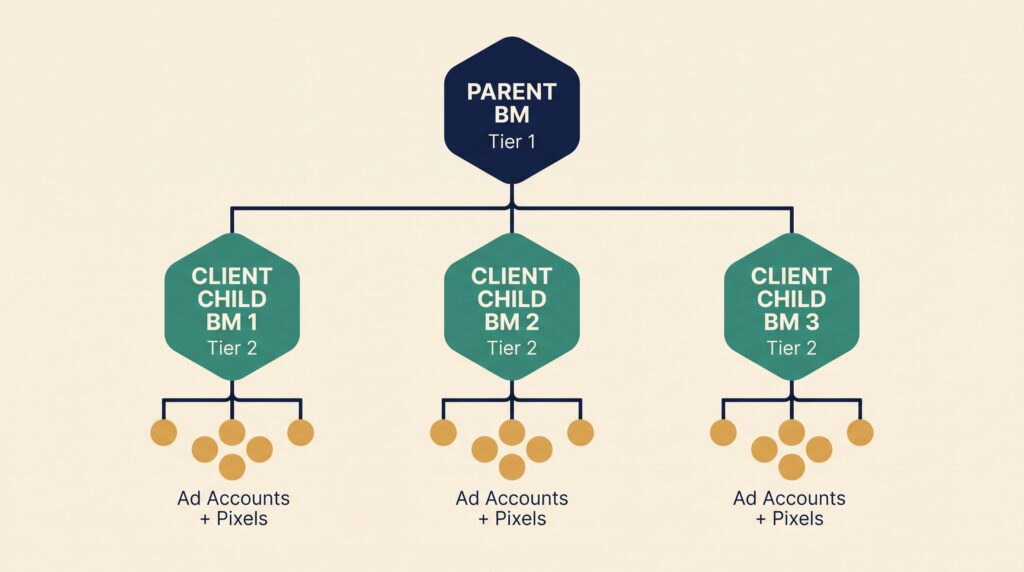
This is the structural one — and the moment when most agencies realise that DIY isn't sustainable. If a single flag or restriction has ever spread from one client to another inside your Business Manager, you have measurable cross-contamination risk. Our deep dive on how cross-contamination spreads inside agency BMs goes through the mechanics — swap for the live URL once W1 publishes May 25.
If a prospect is healthy in every way except that their vertical is "tricky" on Meta — and you're saying no to that revenue because your account infrastructure can't absorb it — that's an infrastructure problem, not a sales problem. Agencies running on managed infrastructure routinely take on clients their DIY peers turn away.
Sophisticated clients ask infrastructure questions because they've been burned before. When a prospect or a current client starts asking how your BM is structured, whether you use credit-line accounts, what your escalation path looks like — they're vetting your operations. If you don't have a clean, confident answer, you're at risk of losing the account to an agency that does.
This one is subtle. It shows up in the language. When account replacement becomes a routine part of how the team talks about their workflow — we just need another one, can we order one quickly? — your operations have drifted into the stack-and-burn model. That's the workflow built around disposable accounts. We covered why that approach silently costs more than it saves in quality vs quantity in ad accounts.


Almost every agency hits this point and tries the same thing first: hire someone (or promote someone) to handle ad account ops internally. It works for a few months. Then the same issues keep recurring, the new hire is doing the same firefighting your senior buyer used to do, and the structural problems underneath — the BM hierarchy, the shared pixels, the missing escalation path — haven't actually been fixed.
The work isn't operational. It's structural. And the structural fix isn't more headcount.
When agencies switch to a partner like Quority, the operational shift is usually visible within the first 30 days.
The pre-flight chaos disappears. Compliance pre-checks, verification, BM setup, and credit-line access are part of the partnership from day one — not separate projects you have to run alongside everything else.
Suspensions get escalated through a real channel. Issues that took your team three days to resolve through standard appeal queues get resolved in hours through partner-level escalation.
Your senior buyer goes back to strategy. The hours that were being absorbed by recovery tasks go back into optimising campaigns and growing client accounts.
It's not a magic fix — the platforms still have discretion, the policies still apply, and human judgment still matters. What changes is the default level of friction your agency operates at every single day.

At Quority, we partner with agencies that have hit the point where DIY ad ops has quietly become more expensive than the alternative. Our partners get a verified parent BM with isolated child BMs per client, credit-line ad accounts, compliance pre-checks built in, and direct support escalation paths into Meta and Google.
If three or more of the seven signs above sound familiar, get in touch with the Quority team. We'll walk you through what switching would look like for your specific setup and which signs we'd address first.
Stacks is a production-ready library of stackable content blocks built in React Native.
block decrease
years of
experience
block decrease
years of
experience

block decrease
years of
experience

block decrease
years of
experience
block decrease
years of
experience

block decrease
years of
experience


