

Education
90%
block decrease
10+
years of
experience
September 2, 2026
5 min read

...and now Meta keeps asking about your Business Manager. Maybe your agency has been running boosted posts or single ad accounts for clients, and it's worked fine so far. Maybe a new client is asking how your account structure is set up, and you realise you don't have a clean answer.
If that's where you are, you're in the right place. A Meta Business Manager (often shortened to "BM") sounds like an admin chore. In reality, it's the single piece of infrastructure that decides whether your agency can scale safely — or spends every quarter recovering from issues a better setup would have prevented.
This article covers what a Business Manager actually is, why every serious agency needs one in 2026, the setup mistakes we see most often, and the signals that tell you you've outgrown your current configuration.
A Meta Business Manager (BM) is a centralised admin platform provided by Meta that allows agencies and businesses to manage Facebook pages, Instagram accounts, ad accounts, pixels, and team permissions in one place — separated from any individual personal Facebook profile. It is the structural layer Meta uses to evaluate trust, verification, and risk across everything an advertiser operates.
Without a BM, every team member has to be a direct admin on every individual page or ad account. That's manageable for one client. It becomes structurally unsafe the moment you have two. With a Business Manager, assets sit inside the BM and team access is granted at the role level — meaning your senior buyer can be removed from a client's account in one click without affecting any other client, and a client can revoke your agency access at the end of a contract without breaking your operations.
For the official Meta documentation on how the system is meant to be used, Meta Business Help Center is the canonical source
There are three reasons the BM has become non-negotiable, and all of them have to do with how platforms now score agencies.
Platform trust signals live at the BM level, not the ad-account level. Meta evaluates your parent BM's age, verification status, complaint history, and policy violations as part of the trust score on every ad account inside it. A clean BM lifts the accounts inside it. A messy one drags them all down.
Business verification is required for almost everything that matters. Spending caps, advanced targeting, certain ad formats, the Lead Ads category, and access to platform support all depend on verified business status — and verification happens at the BM level. Without a properly verified BM, your agency runs into invisible walls constantly.
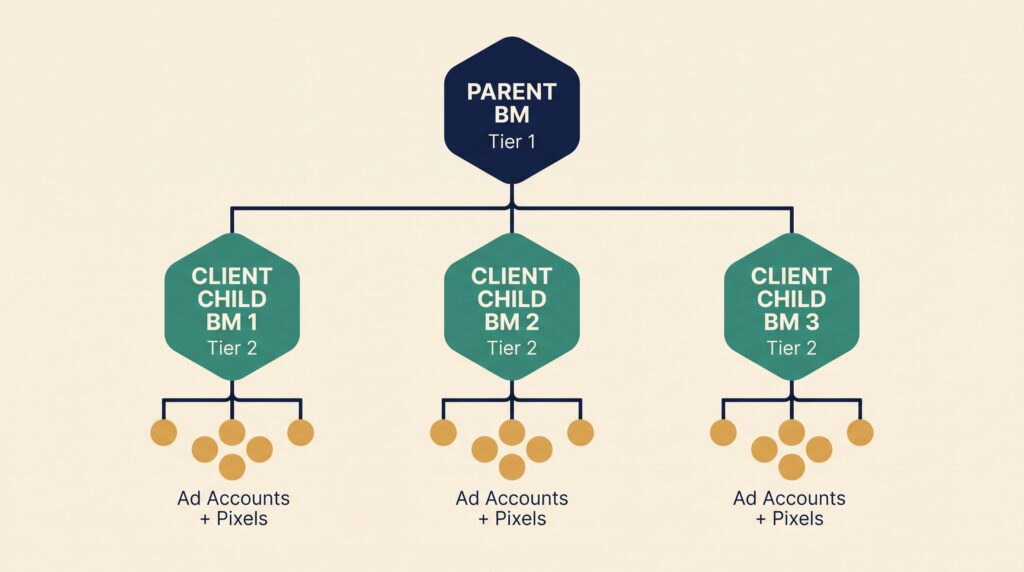
Client isolation is impossible without a proper BM structure. When one of your clients gets flagged, the damage either stays contained or spreads — and the difference is entirely structural. We wrote a full breakdown of how this works in our guide to managing multiple client ad accounts without cross-contamination risk. The short version: without isolated child BMs per client, one client's bad ad can affect three of your accounts.
The agencies still running without a properly structured BM in 2026 are usually new, or they've grown faster than their infrastructure. Both are fixable. Both stop being fixable cheaply once a major client is involved.
There's no exact spend threshold where DIY stops working. The clearer signals are operational.
These are the points at which most agencies stop seeing Business Manager setup as an admin task and start seeing it as the foundation it actually is.
Meta Business Manager is a free central hub where an agency manages all its ad accounts, Pages, pixels, and team permissions in one place, kept separate from personal Facebook profiles. It's the foundation every stable agency setup is built on.
Yes. Running client ad accounts through personal profiles or scattered logins creates security and stability risks. A Business Manager gives you centralized access control, cleaner account separation, and the professional structure Meta expects in 2026.
The biggest ones are mixing multiple clients' assets under a single account, granting broad admin access instead of role-based permissions, and skipping business verification — each of which raises the risk of restrictions and lost accounts.
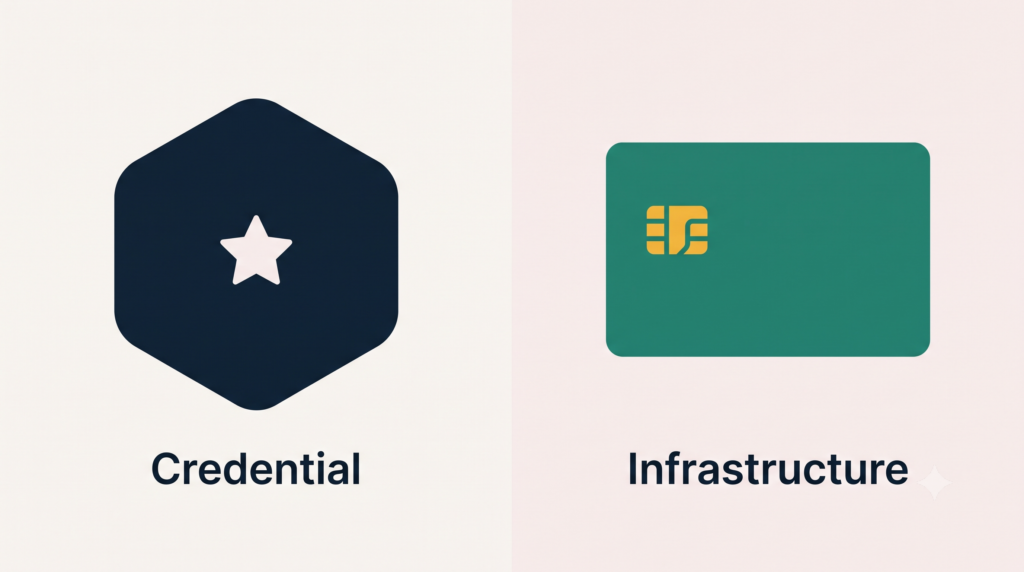
When you're juggling multiple clients, hitting spend limits, or facing repeated restrictions, a single self-managed Business Manager stops scaling. That's the point to move to dedicated ad-account infrastructure with proper isolation and support.


At Quority, every partnership begins with a clean Business Manager build: a verified parent BM, isolated child BMs per client, properly assigned partner access (not admin), one pixel per advertiser, and credit-line ad accounts that sit inside the structure from day one. It's the setup we'd want any serious agency to have — and the default for every Quority partner.
If you're unsure whether your current BM setup is doing more for you than against you, get in touch with the Quority team. We'll review your structure and tell you what's working, what isn't, and what to fix first.
Stacks is a production-ready library of stackable content blocks built in React Native.
block decrease
years of
experience
block decrease
years of
experience

block decrease
years of
experience

block decrease
years of
experience
block decrease
years of
experience

block decrease
years of
experience


