
Education
October 8, 2026
5 min read


And your accounts are starting to slow you down. The daily spend cap won't budge. A rejection on one account is creating knock-on issues in another. Your senior buyer is spending Wednesday morning on appeals instead of optimising campaigns that are actually working.
This is the friction pattern of an agency whose infrastructure hasn't kept pace with its growth. And it's almost universal — not because agencies make bad decisions, but because the infrastructure that works cleanly at $50K is genuinely not built for $250K. The two stages have different structural requirements, and the gap between them only becomes visible once you're already in it.
This article maps the three growth stages and what each one actually requires — not in theory, but based on the account structures we see hold and the ones we see crack.
Agency ad spend infrastructure refers to the full stack of structural elements that allow an agency to run paid media campaigns at a given volume without account-side friction becoming a material cost: Business Manager hierarchy, ad account types, credit and spend-cap access, compliance tooling, support escalation paths, and account health monitoring. The requirements shift meaningfully at three spend thresholds — $50K–100K, $100K–250K, and $250K–500K monthly — not because platforms change their rules at those numbers, but because account complexity, compliance exposure, and the cost of a single failure all compound at scale.
The agencies that scale cleanly through all three stages are not the ones with the best media buyers. They're the ones who treated infrastructure as a business function before they needed to — and had a partner who'd done it before.
At this stage, the platform is relatively forgiving. Volume is low enough that a single rejected ad or a short suspension doesn't materially affect delivery. But this is exactly when the structural decisions get made — and bad ones become very expensive later.
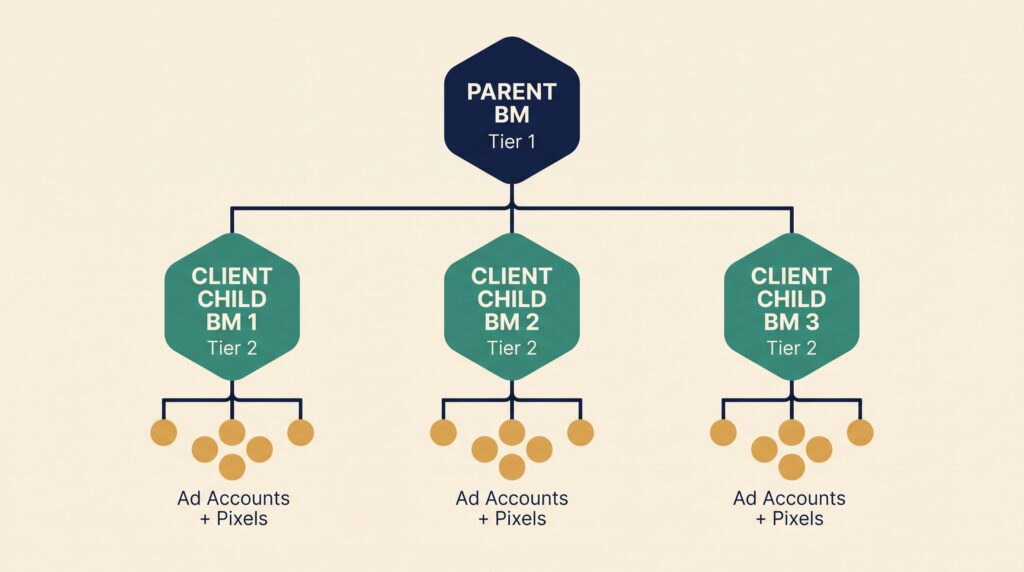
The single most important thing to get right at Stage 1 is isolation. Most agencies at $50K are running clients through shared infrastructure: one Business Manager, shared pixels, a single payment method across accounts, admin roles that span multiple client structures. It works until it doesn't.
What Stage 1 infrastructure looks like when it's done correctly:
The agencies that skip this work at Stage 1 spend Stage 2 trying to retrofit it under pressure — with live campaigns, paying clients, and no margin for downtime.

This is where the most agencies hit their first serious infrastructure wall — and where the gap between "we have accounts" and "we have infrastructure" becomes financially visible.
The spend cap wall is the most common symptom. Standard-owned Meta accounts cap daily spend at $750 or $2,500, depending on account age and trust score. At $100K+ monthly, your top clients are almost certainly brushing up against these limits. Pushing the budget harder doesn't move them — the platform is waiting for trust signals that take months to build organically. We covered the mechanics of why your Meta daily spend limit won't go up.
Credit-line agency accounts are the structural answer. Moving your highest-spending clients onto credit-line infrastructure gives them the spend headroom standard accounts can't provide — because the parent BM already carries the trust signals. The wait is gone.
The compliance exposure also increases materially at this stage. At $100K+ monthly, you're running significantly more ads across more clients. Manual pre-launch review works at 40 campaigns; it starts breaking at 200. What gets missed — claims, disclosure placement, landing page offer mismatches — shows up as rejection spikes that gradually damage account trust scores, which makes future approvals harder, which creates more rejections. The cycle compounds quietly.
What Stage 2 infrastructure looks like when it's done correctly:
A real escalation path. Standard support queues run in days. Knowing who to call — and having a relationship that makes that call productive — is worth more than any amount of post-suspension appeal work.
Credit-line accounts for clients spending $15K+ monthly. This is the non-negotiable upgrade at Stage 2.
Structured compliance pre-checking — creatives and landing pages reviewed against current policy before launch, not after the first rejection.
Rejection-rate monitoring per account. A rising rejection rate is almost always visible 5–7 days before it triggers an account-level review. Catching it early is an infrastructure function, not a luck function.

At $250K–500K monthly, the agencies that are scaling cleanly are not managing their infrastructure — they have a partner managing it for them. The ones that are fighting are usually trying to run Stage 3 volume on Stage 2 tools, with an in-house team absorbing the gap.
The main structural risk at this stage is network exposure. With 30–80+ clients running through the same account hierarchy, one bad actor can create systemic damage. One client with a policy violation, one landing page rejection spike, one payment inconsistency — and the knock-on effects move faster than any team can manually catch them. We covered how this spreads structurally in how to manage multiple client ad accounts without cross-contamination risk.
What Stage 3 infrastructure looks like when it's functioning correctly:
Direct escalation paths into Meta and Google. At $250K+ monthly, the difference between resolving a suspension in 4 hours and 72 hours is a commercial issue. Standard appeal queues are not the answer at this scale.
Credit-line accounts across the board — not just for top clients. At this scale, the trust-score inheritance from a verified partner BM is a commercial advantage, not a nice-to-have.
Automated health monitoring. You cannot manually track account quality signals across 50+ clients. You need a system that flags rejection-rate changes, quality-score drops, and policy anomalies before they become account-level problems.
Anomaly detection. Sudden rejection spikes, unusual spend patterns, and creative-approval failures that deviate from baseline — all of these should trigger a flag, not a discovery call with your buyer two days later.
The structural failures at each stage are predictable. But four risks consistently catch agencies off guard — because they're quiet until they're not.
Shared pixels silently linking clients. A single Meta pixel installed on multiple client sites creates invisible entity linkage the platform reads continuously. One client's declining engagement can pull another client's account into review without any direct relationship between their campaigns.
Compliance debt compounding. Every rejected ad leaves a mark. Agencies that run high rejection rates over months accumulate account quality damage that makes future campaigns harder to approve — even when the creative is clean. Most agencies don't connect the current rejection to the historical pattern.
Platform policy drift. Meta and Google update their policies quietly and frequently. What passed manual review six months ago may not pass today. Without a pre-check process that refreshes against current policy, agencies are continuously running against yesterday's rules.
The senior-buyer cost that doesn't show up on a P&L. When a senior media buyer is spending 6–8 hours a week on account-side recovery — appeals, verifications, policy reviews — that cost is invisible in most agency reporting. It shows up in client outcomes and team morale before it shows up in the numbers.


Scaling spend should not mean adding chaos. At Quority, we partner with agencies at every stage of the $50K to $500K journey — providing the verified BM hierarchy, credit-line agency accounts, compliance pre-approval, health monitoring, and direct escalation paths that each stage actually requires.
Whether you're setting up your account structure properly for the first time, breaking through the spend-cap wall at Stage 2, or building the full monitoring and escalation infrastructure for Stage 3 volume, the model is the same: the right infrastructure for your current stage, already in place before the next one creates friction.
Get in touch with the Quority team to map the right account infrastructure for your next growth stage.
Stacks is a production-ready library of stackable content blocks built in React Native.



block decrease
years of
experience
block decrease
years of
experience

block decrease
years of
experience


