
Education
October 8, 2026
5 min read


And somehow three of your accounts go down with it. No warning, no clear connection between them — just a cascade of restrictions that takes a week to unpick and costs you a client conversation you didn't want to have.
If this has happened to your agency, you've already met cross-contamination. It's one of the quietest structural risks in agency ad ops, and most teams don't realise their Business Manager has it until the damage is already done.
In this article we walk through how cross-contamination actually spreads inside an agency setup, the patterns that cause it, and the account structure that contains the damage when something does go wrong.
Meta, Google, and TikTok don't evaluate ad accounts as fully isolated units. They evaluate the network of relationships behind each account: which pixels are shared, which business entities are linked, which admin profiles have access, which payment methods are reused, which creatives have been used before.
When a flag lands on one node in that network, the platform applies pressure to nearby nodes. It's not malicious — it's how trust scoring works at platform scale. And it's why a single client's bad ad can quietly affect the accounts of two or three other clients you serve, even when those clients have nothing to do with each other.
The simplest way to think about it: every shared piece of infrastructure between two clients is an invisible link that platforms can see, even if your team can't.
Across the agency setups we audit, contamination almost always moves through one of four pathways.
Shared pixels and tracking infrastructure. Two clients running on the same pixel — whether intentionally for data, or by accident during onboarding — means a quality issue on one campaign reflects on the pixel itself. And the pixel reflects on every account using it.
Linked business entities. When ad accounts sit under the same Business Manager hierarchy without proper isolation, a structural-level penalty on one account can flow up to the parent and back down to siblings.
Recycled creative assets. Re-uploading the same creative across clients — even with small text edits — reuses the underlying asset hash. A rejection on that creative in one account can flag it across the others.
Shared payment methods or admin profiles. A single business credit card across BMs, or a personal Facebook profile with admin rights on multiple client accounts, creates a discoverable connection that platforms factor into account scoring.
None of these are catastrophic on their own. The problem is that they compound. An agency managing ten clients with shared pixels, shared admins, and shared creatives has built thirty-plus contamination pathways without realising it.
When we onboard a new agency to Quority and audit their existing setup, the same handful of patterns turn up almost every time.
One pixel, many clients. A "master pixel" set up in year one, reused as clients onboarded. By year three, it carries the quality history of every advertiser it's ever served — and every rejection any of them ever received.
Shared payment method across BMs. Same business credit card used for billing across all clients to simplify finance. Platforms treat this as a single financial entity and score the accounts as connected.
Recycled creatives across accounts. Winning creatives duplicated client-to-client to save time. The creative hash is identical. A flag on one travels to the others.
Personal admin profiles linking multiple BMs. A senior media buyer admins six client BMs through their personal Facebook profile. Their personal profile becomes the connecting tissue between every BM they touch.
Cross-client retargeting audiences. Custom audiences built from one client's pixel and applied to another client's campaigns. Beyond the legal exposure, platforms read this as data-sharing across accounts.
If you recognise more than two of these in your current setup, you have measurable contamination risk today.


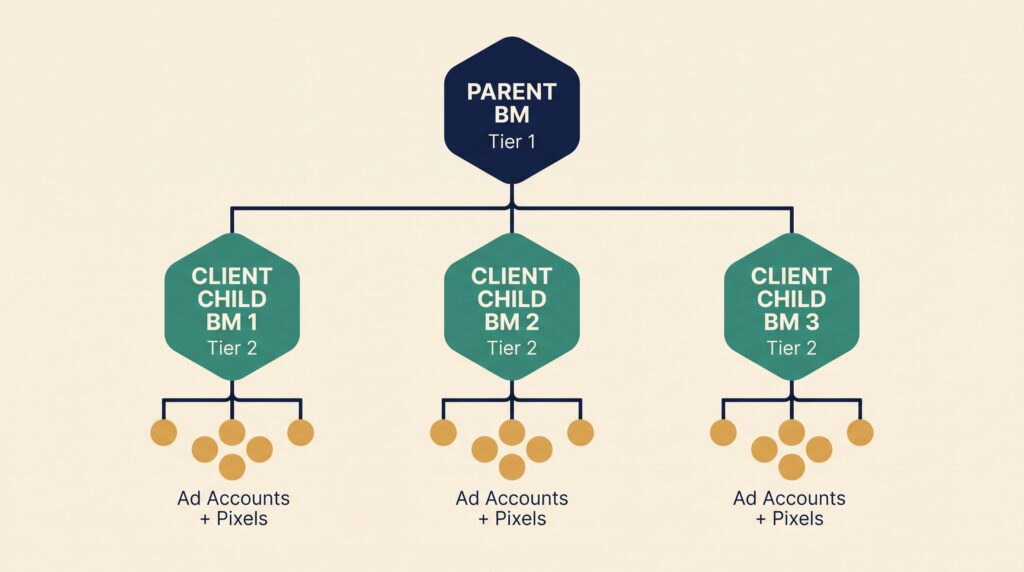
The fix isn't "be more careful." Careful doesn't scale. The fix is structural — every layer of the stack has to be isolated by client by default, so that a problem in one client's account has no pathway into another's.
A clean structure looks something like this:
It's not glamorous. It is, however, the actual structural difference between an agency that loses one account when a client misbehaves and an agency that loses three.
Most agencies find this kind of article after the structural damage is already there. That's fine — the migration is doable.
Audit your setup first. Map every pixel and which accounts use it. Map every payment method and which BMs it touches. Map every admin and the BMs they admin through. The risk picture becomes obvious within an hour.
Migrate gradually. Don't move everyone at once. Start with your highest-value client, set up a clean child BM with its own pixel and admin structure, run a 14-day overlap to validate delivery, and cut over. Repeat per client.
Retire your highest-risk legacy assets. Old pixels with rejection history. Old creatives carrying flags. Old payment methods tied to multiple BMs. None of them belong in your clean structure.
You don't need to rebuild your entire agency — you need to make sure your contamination pathways stop growing while you migrate the most valuable accounts first.

At Quority, we provide agencies with access to premium Meta and Google agency accounts with credit lines in place — without the certified partner requirement. Our accounts are properly established, actively monitored for health, and backed by direct support access so that issues get resolved fast when they arise.
If you're currently running on standard accounts and hitting payment friction, spend cap limitations, or account stability issues, the infrastructure upgrade is usually faster and simpler than agencies expect. Find out if your agency qualifies — get in touch with the Quority team and we'll walk you through what access would look like for your setup.
Stacks is a production-ready library of stackable content blocks built in React Native.



block decrease
years of
experience
block decrease
years of
experience

block decrease
years of
experience


